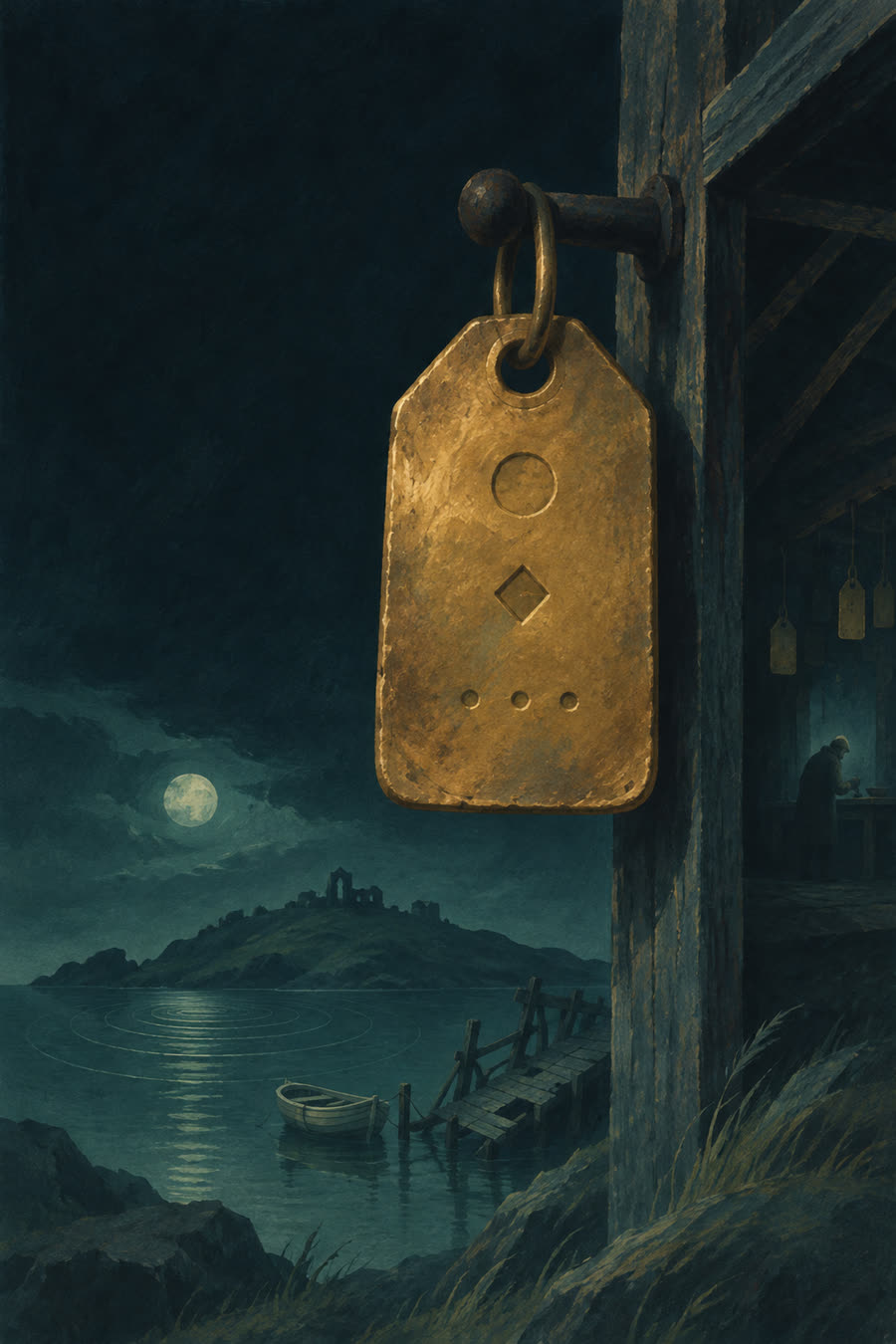
"No," Piers said at last, and the word sat on the slip like a dropped coin. "Not if you mean will I come back because I am told to. I have been told to do everything since I was nine. The order, the Cabinet, the boat. I was told to break this one, and I carried it down instead, and I do not know why."
Odda waited. Her mother had taught her that a person who is allowed to finish a sentence usually finishes the true one.
"But you asked me," he said. "Nobody has asked me anything in years. They hand me a paper and I read it back. So if you are asking, then yes. I will come back. I would like to know where I am coming back from first."
"That is the right answer," said the figure in the long coat, and it sounded almost tired. "It is the only kind the boat takes."
The oarsman's skiff touched the stones below the slip with no more noise than a hand laid on a table. He was a broad man in oilskins gone stiff and white with salt, and he held his hat in front of him, as if he had come to a funeral. Behind him, the two other lights drew in and were not lanterns at all. They were jars, hung from poles, and in each jar something small and steady burned the colour of a tag fresh from the stamp. Two women held the poles. Odda knew neither of them. Both wore her mother's way of knotting a scarf.
"Pilot's crew," the oarsman said, and put his hat on again. "Late, and sorry for it. The last Aldane never gave us warning either."
"You rowed in from the bell," Odda said.
"We rowed from the water, mistress. The bell is not ours." He turned his head toward the town, where the sound was coming slowly up through the dark, one stroke to every ten breaths. "That is the schoolhouse. Somebody has found the rope."
Piers had gone the colour of the boat. "The Cabinet has no bell."
"It has now," said the figure, and for the first time it looked at Odda directly, a small plain face she thought she might have seen once, bending over her cot. "Ring it for a hundred strokes, and every tag on Skerrimoor will be asked to give its state at once. That is what the Directing Office wants. Not to destroy the tags. To hear them all say 'sound' together, so that the count can be closed in one stroke and the mainland can say nothing is owed."
"And are they sound?" Odda asked.
"Yours is." The figure touched the brass inside its own coat. "Mine is not. Nor is his."
Piers opened his burning palm and looked at it. The backwards letters had begun to move, very slightly, like a word being learned. "What happens to me if the hundredth stroke falls?"
The woman with the nearer jar answered, not unkindly. "You are written off as paid. And then you are paid. Those are not different things, to the Cabinet."
Odda looked at the harbour office window, dark, with her thirty-one years of tags above it, and at the bone-pale boat, whose blank bow now held one letter of light, an upright stroke like a mast. She put her hand flat on the gunwale beside Piers's. It was warm. It was warmer than a thing carved from nothing had any business being.
"Then we do not have a hundred strokes," she said. "We have, what, ninety?"
"Eighty-eight," said the oarsman, who had been counting.