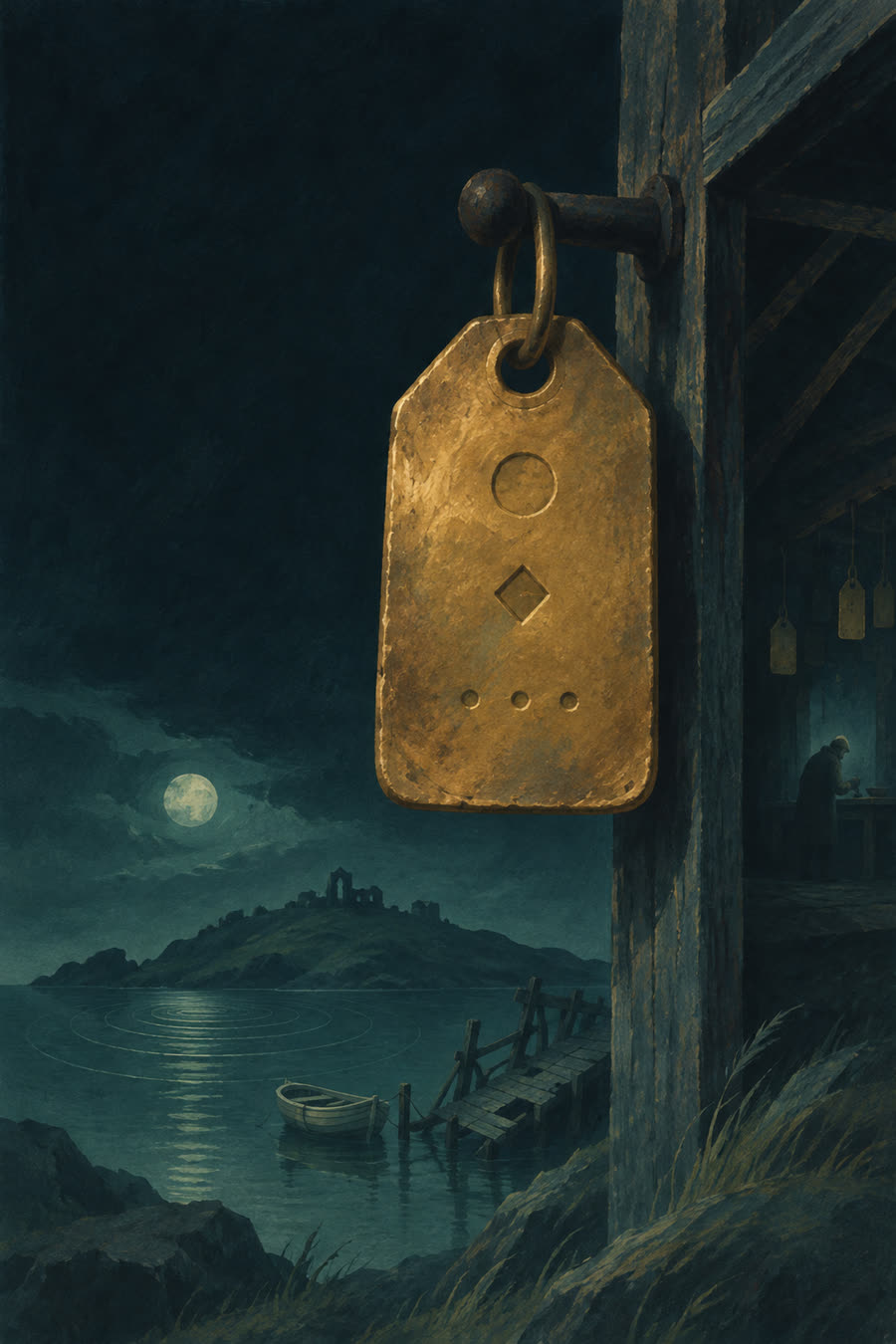
Nobody spoke while the boat settled. The water at the foot of the slip had gone flat and dark, and it lay against the stones the way a dog lies against a door.
"It is waking," said the figure in the long coat. "Not all the way. It wants someone to say what it is carrying."
Odda had brought the red lamp down from the quay end, and she kept it low. The red glass threw a small stain across the wet planks, and in it she could see Piers's hands, white at the knuckles on the gunwale. He had not let go since they set the boat down. She did not think he knew.
"Carrying what?" she said.
"A share," said the figure. "The last Aldane who took this boat out left one unpaid. A stranger's share. The island kept the count open for it, all these years, and your mother kept the entry. That is what a Passenger Kept is, Odda Fenwick. Not a prisoner. A sum nobody has settled."
"I am not an Aldane by choice," Piers said. His voice cracked on it, and he tried again. "I was given the posting. A man in the Directing Office read my name off a list and said I was suited. I thought it was because I could write a fair hand."
"Who was the man?"
"I never saw his tag." He laughed, a short ugly sound. "They do not wear them, on the mainland. I thought that was progress."
Out on the water the steady lantern drew nearer, and now Odda could see it plainly: a boat with a single oarsman, rowing in no hurry, and behind it the two other lights, close together, like eyes. None of them carried a tag she could read at that distance. All of them were coming to the condemned slip, the one place on Skerrimoor where no honest boat had landed in forty years.
She turned to the figure. "If I read the entry, if I say it aloud, does it close?"
"It might. Or it might call whatever is owed." The figure's face stayed in the shadow of the collar. "Your mother chose not to find out. She left it for two, one of the island and one not. She trusted you to decide better than she could."
"She trusted me to do the sums," Odda said. "She always did." She felt it then, the old tightness behind the breastbone, the habit of thirty-one years: do not guess, read the tag. But the tag had been read, and it had only told her the shape of the hole, not what filled it.
The boat knocked once against the stones. The pale hull seemed to brighten, as though a lamp had been lit inside the bone. On the bow the blank beside the word Pilot gave a faint, patient glow.
Piers let go of the gunwale. He looked at his palm, where the pale hull had left a faint mark, a row of tiny stamped letters pressed into the skin. ALDANE, backwards, as on a die.
"It has already begun to count me," he said.
"Yes," said the figure gently.
Odda lifted the red lamp until it lit all three of them. Then she did the thing she had meant to save for the Cabinet in the schoolhouse. She asked a question she did not know the answer to, and she asked a person.
"Piers. If I put my hand on this boat beside yours, and it takes us both out to meet that lantern, will you come back?"
He did not answer at once. The oarsman shipped his oars. Somewhere behind the lights, a bell that Odda had never heard began, very slowly, to ring.