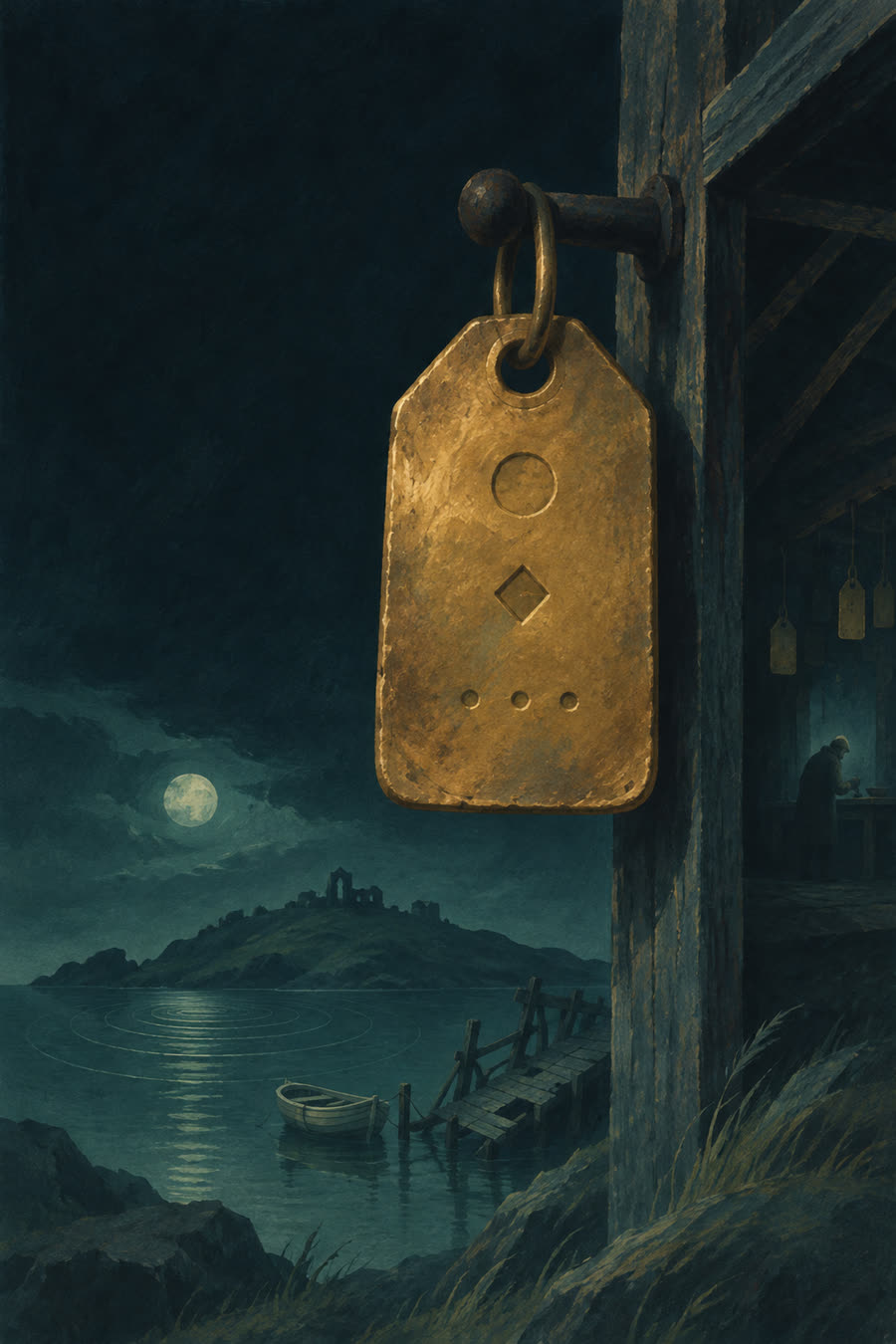
Nobody spoke for the space of one breath, and in that breath the bell struck again from the schoolhouse, a flat note that sat on the water like a stone. The oarsman's lips moved. "Eighty-seven," he said, pleased, as if the number were a fish he had landed.
Odda did not look at him. She looked at the jars the two women carried. In thirty-one years she had read ten thousand tags by lamplight, and she knew the colour of that glow: the pale yellow of a tag that has just been stamped and not yet argued with. She stepped close to the nearer woman and turned the jar by its neck. A tiny brass tag hung from the cork, and it read Borrowed.
"Borrowed from whom?" she said.
"From the count," said the woman, and smiled the way a person smiles who has been told not to say more.
The boat shifted on the slip's wet planks. Its iron tiller had swung round on its own and now pointed out past the harbour wall, where the dark was thickest. Piers laid his stamped palm on the gunwale and snatched it back. "It's warm," he said. "Like it's been running."
"It has been," the figure in the long coat said. Its voice was dry, without hurry. "Eighty-seven strokes, and then every tag on this island says sound, and I am a sum that was settled. Do you know what happens to a settled sum, Miss Fenwick? It is not carried. It is put down."
"Put down where?" said Piers.
The figure turned the tag on its pin, so that the line in Odda's mother's hand showed in the lantern light. Put ashore by an Aldane. "Ask the one who rings," it said.
Odda had thought of the bell all through the last ten breaths, and she had come to a plain conclusion. A bell needs a hand, or it needs a reason, and she did not trust a reason that arrived with a crew. She took Piers by the sleeve, not hard, the way her mother used to take hold of a tag before hanging it.
"I need someone to go up to the schoolhouse and see what is pulling that rope," she said. "I would go, but my knees count in tens as well, and the boat should not be left with these three. Will you go? I am asking."
Piers looked at the boat, at the oarsman, at the light in the jars, and last at his own palm, where the backwards letters had gone faintly red. "Yes," he said. "And when I come back, you tell me what Aldane put that person ashore. Not what the tag says. What happened."
"If I know it by then."
"Then tell me what you don't know." He was already running, his city shoes slapping the stones, and the oarsman called after him, not unkindly, "Seventy-nine by the time you reach the door, clerk. Mind the third step."
Odda stayed on the slip with the oilskinned man on her left and the long coat on her right, and the pale boat between them shifting gently on its cradle, though there was no tide to shift it. She took her mother's pencil stub from her pocket, the one she kept for amending tags, and on the back of her hand she made a stroke for every one the bell had given. Thirteen. It was not a bad way to keep the count.
At the schoolhouse, Piers found the third step loose and the door ajar. Inside, the grey cabinet hummed its steady note, and a long rope hung from the ceiling through the bell loft, swinging back and forth. No one stood beneath it. But the humming stopped for exactly the length of one stroke, and began again after.
He put his hand on the rope. It was warm.