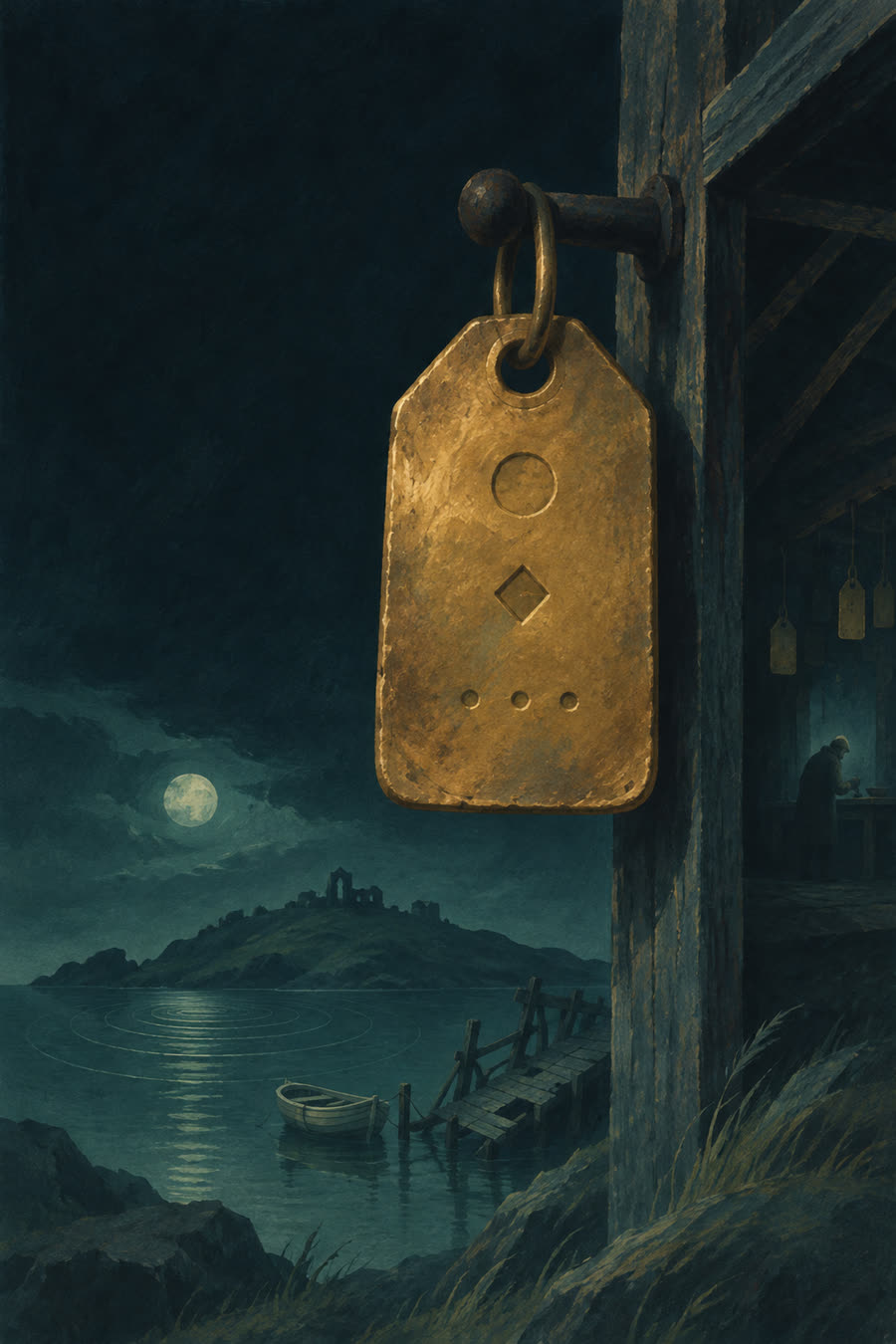
Piers was the one who pulled the tarpaulin away, because Odda's hands would not do it. It slid off with a dry whisper and lay in folds on the floor of the net shed, and the lamp on its hook showed them the whole boat.
It was longer than any boat on Skerrimoor and far narrower, built of some wood bleached to the colour of bone. There were no oarlocks along the gunwales. There was one thwart, one tiller of black iron, and in the bow a brass tag gone green at its edges. Odda did not need to read it. Pilot, Sleeping. She had polished it every spring of her life, through the wall of the shed, in her mind.
"It is not heavy," said Piers, and he lifted the stern a hand's width off the trestles with one arm. He looked startled at himself. "It is hardly anything at all. What is it made of?"
"I do not know," said Odda. "My mother never said, and I never asked. I thought that if I asked, someone would answer."
Out beyond the shed wall the harbour bell had stopped. In the quiet she could hear the sea slapping the condemned slip, and under it a lower sound she could not name, a patient scraping, as of a keel finding stone.
She made herself walk round the boat. Under the stern thwart a small locker had been fitted, its lid fastened with a wooden peg instead of a lock. Inside lay a folded square of oilcloth, a candle stub, and a slip of paper so old it had gone the colour of tea. The writing was her mother's, upright and cramped, the same hand that had stamped the first tag.
Odda read it twice, then once aloud, because Piers was watching her face.
"The pilot wakes when she is carried to the water by two. One must be of the island. One must not."
Piers stood very still. "I am not of the island."
"No."
"Your mother could not have known me." He said it carefully, like a clerk reading back a figure he did not trust. "I was a boy on the mainland when she died. I had never heard the name Skerrimoor."
"She did not know you," said Odda. "She knew that someone would come, one day, from the other side, with an order in his hand." She folded the paper along its old creases. It felt wrong to find that her mother had expected the Directing Office, and had not been surprised.
Piers looked at the long pale hull, then at the door, where the night showed a thin grey strip. "My order says this boat is to be broken up with the rest. Tags retired, objects cleared." His mouth worked. "I have not done it. I should say that I have not done it yet."
"Then do something else first," said Odda. "Take the bow."
For a moment she thought he would refuse. Then he came round and took hold of the stem beside the green tag, and she took the stern, and they lifted. The boat rose between them as if glad of it. Its keel came off the trestles without a sound, and a cold ran up Odda's arms that was not the night air.
They had gone three steps toward the door when the tag on the bow began to tick, once, softly, like a cooling stove. Piers flinched but did not let go. On the back of it, where the stamping had always been smooth, Odda saw fresh letters rising through the brass as though pressed from within, and she could not yet make out the word.
Outside, on the slip, the figure raised one hand and held it there, waiting.