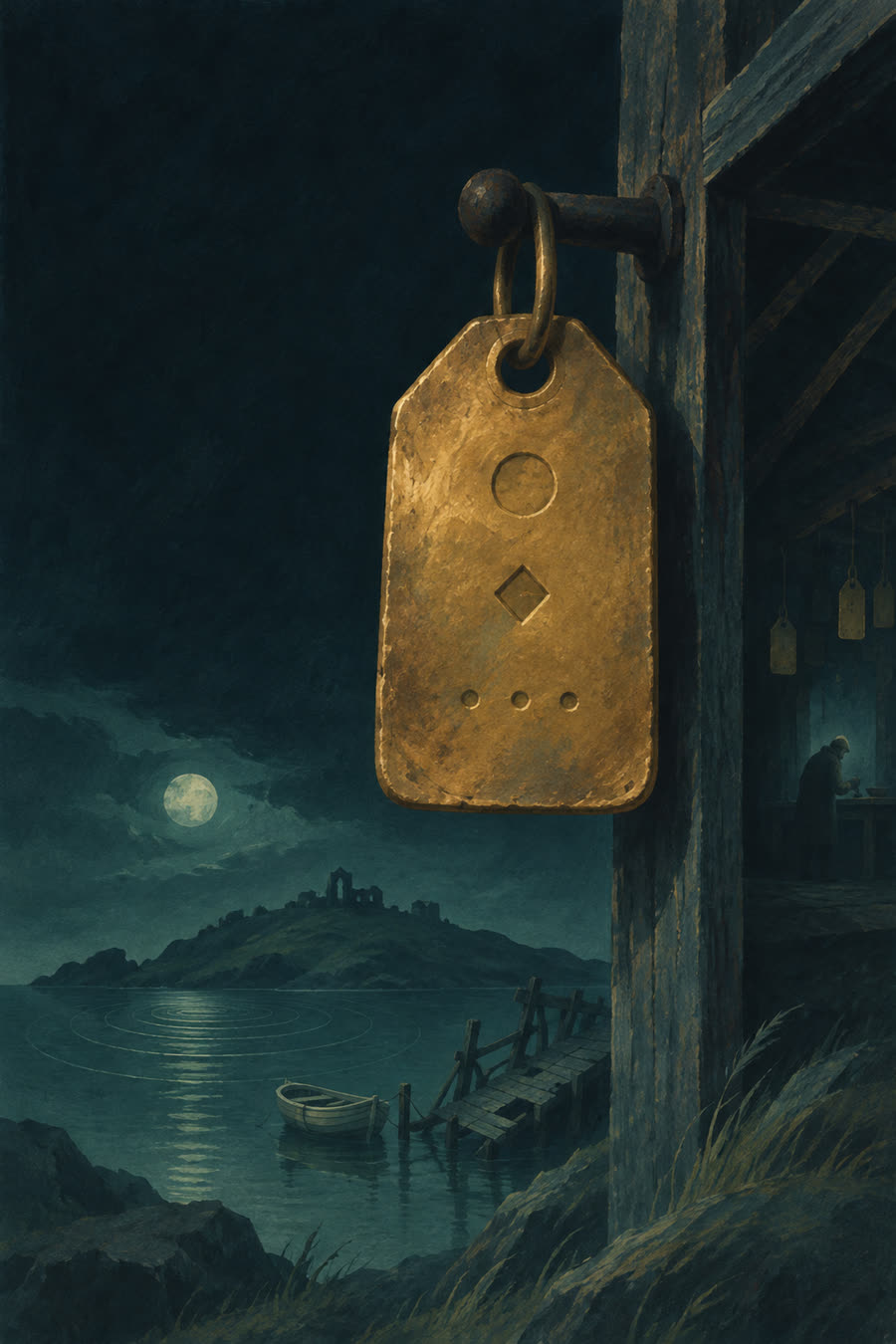
Odda did not go back up the stairs to the tag room. She had no need to. She knew the back of tag number 4 the way she knew the grain of her own table, three lines in her mother's cramped hand, pressed so hard into the brass that the letters stood up on the other side like scars.
The first line was a pattern. Three long, one short, two long. The second line said: Answer it once, never twice. The third said: Then wake the pilot, whatever the tag says.
For thirty-one years she had taken that for a sailor's superstition, the sort of thing her mother wrote when she was tired. Now a stranger beyond the breakwater was making the pattern with a lantern, and the second line was suddenly an instruction.
"Miss Fenwick," said Piers. He had stopped pretending to look at his papers. "You have gone a bad colour. Is it the light? I can fetch someone."
"You can fetch me the lamp cover," she said. "The one on the hook inside the office door. Fast, please."
He went. She was glad he did not ask why. When he came back she took the cover from him, fitted it over the signal lamp, and worked the shutter with her thumb. Three long. One short. Two long. Her wrist remembered what her mind had not been taught, and the shutter clacked in the same rhythm as the old harbour clock.
Out on the black water the lantern held perfectly still.
"That is it," Piers whispered. "They have seen you. Who is it?"
"Once," said Odda, mostly to herself, and she shut the lamp and put the cover down. Her hands were shaking, which annoyed her.
The lantern did not move for a long minute. Then it swung wide of the rocks, a slow clean curve, and began to come in toward the old stone slip at the far end of the quay, where no boat had been allowed to land since the ferry went down.
"That slip is condemned," said Piers. "There is a tag on it. I read it this morning. Slip, Unsound."
"There is a tag on everything." Odda was already walking. "Come if you are coming. Bring your clipboard, if it helps."
He came. The wind had turned and smelled of weed and cold iron. As they passed the net shed she stopped at its padlocked door, where a brass tag swung on a wire, the fellow of the one on her hook upstairs. Pilot, Sleeping. She had read it perhaps ten thousand times and never once asked what it meant by sleeping. A pilot was a man, or a woman, or a boat. A tag did not say.
"The pilot was my mother's," she said. "That is all I will tell you tonight. Her boat, kept in there, under a tarpaulin. Nobody has touched it since she died, because the tag said not to."
Piers looked at the tag, then at her. "Then you are not going to follow the tag."
"I am going to follow my mother," said Odda. "It is not the same thing, and tomorrow I will not be able to explain the difference to your Directing Office." She took the key from the nail inside her coat, where she had worn it so long she had forgotten it was a key. "But the tag cannot make a boat sleep. Only people do that."
The padlock was stiff with salt. It took both her hands and a word her mother would not have liked. Behind them the lantern grew steadily larger, steady as a held breath, and beneath it a figure was just now visible, small, upright, one arm lifted as if to wave or to be counted.
The door opened with a groan. Under the tarpaulin something pale and long waited in the dark, and Odda found she was afraid of it, more than she had been of the lantern.