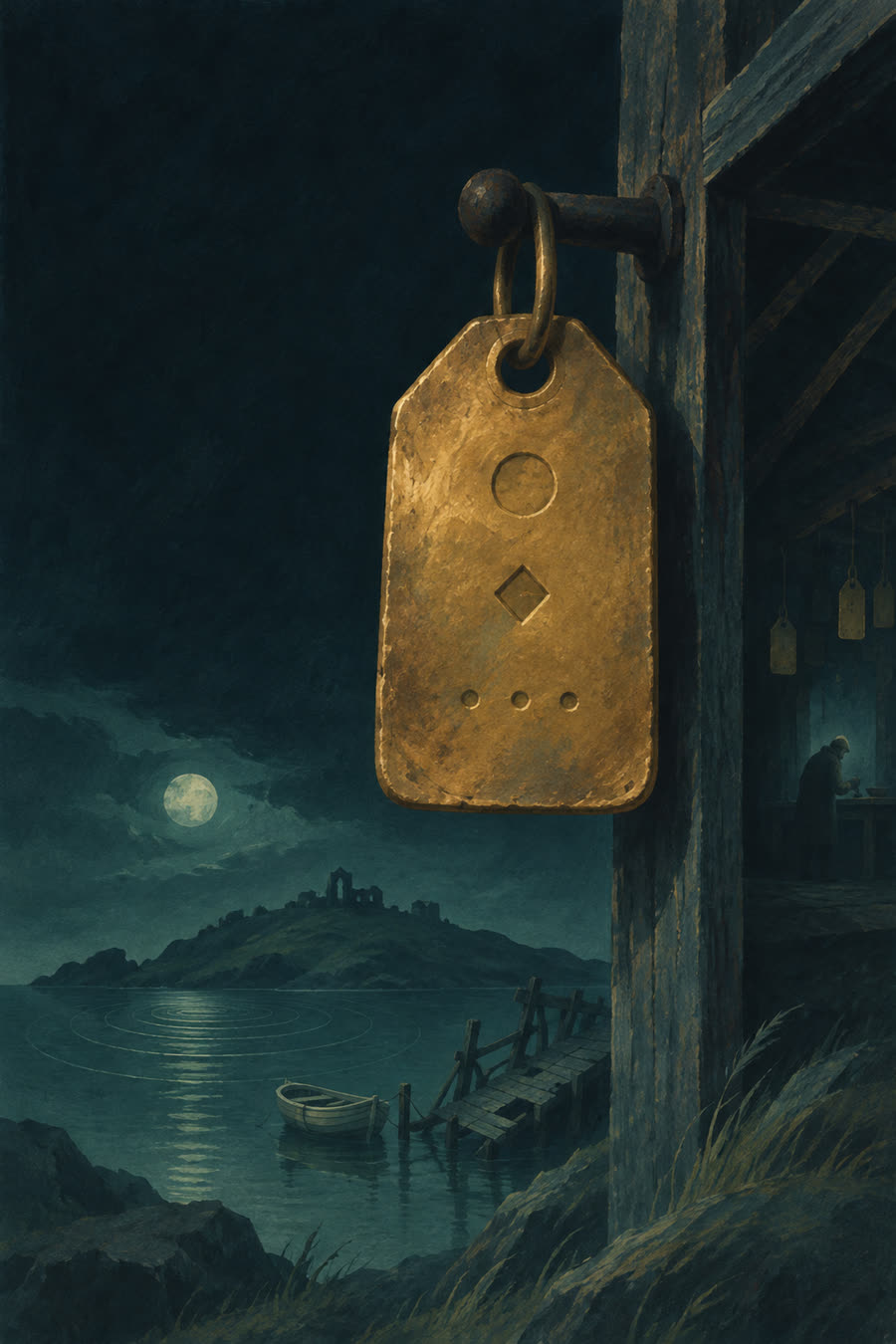
Pilot, Sleeping. The brass said it plainly, as it had said it every night for nineteen years. But the pilot had not stirred, Odda knew that, and still a lantern was moving out past the breakwater as though someone knew the channel and had decided against it.
"It's wrong," said Piers. He was at the window with his thin hands flat on the glass. "The tag, I mean. Or the lantern is."
"The tag is not wrong," said Odda. "The tag says who is not piloting. It does not say who is rowing."
She hung it back on its hook, harder than she meant to, and the little brass sound of it went through the room. Then she took her coat from the nail and was down the stairs before the boy had finished turning round.
The harbour was black and wet, and the wind had the taste of iron. Odda went straight along the quay to the bell post and rang it again, three strokes, then three more, which was the old call for turn about, you are going wrong. Out on the water the lantern did not pause. It rose and dipped, rose and dipped, a slow tired swing, the way a light moves when it is held by someone who is not rowing hard but only drifting with intent.
"Can we send the lifeboat?" Piers had caught up, breathless, his clerk's shoes slipping on the stones.
"The lifeboat is tagged Oars, Missing. Since Tuesday."
"Then why has nobody..."
"Because the tag was only hung on Tuesday, and Tuesday is when the man who mends oars went to his sister's." She heard how that sounded. It sounded like an island that had been waiting a long time to be told how foolish it was.
Piers did not say it. He looked at the lantern, then back at the dark bulk of the harbour office behind them. "The Cabinet would know who it is," he said quietly. "It would just say."
"It would say what it had been told," said Odda. "And nobody told it about this."
She was not sure that was fair, and she said it anyway.
Then she did the thing she had not done in thirty-one years: she walked past the tag room door, past the stove, and into the storeroom behind, and came out with the big signal lamp with its red glass, the one her mother had used once, in a winter Odda was too young to remember clearly and old enough never to forget. She set it on the end of the quay and lit it. It threw a hard red road across the swell.
"What does that mean?" asked Piers.
"It means someone on land is awake and looking at you." She straightened. "That is all any light has ever meant."
For a moment nothing changed. Then, far out, the small lantern stopped swinging. It hung quite still. And then, slowly, it began to move in a different way: up, and across, and down, a pattern Odda knew before she knew she knew it, because it was stamped on the back of tag number 4 in her mother's cramped hand, three lines she had read twice that evening and told to no one.
Her mouth went dry. Beside her Piers said, "Is that a signal?"
"Yes," said Odda. "It's an answer."
"To what?"
She did not tell him. She watched the lantern make its pattern again, patient and exact, like a person who had been rehearsing it for years, and she thought: someone out there has read the back of the tag too.