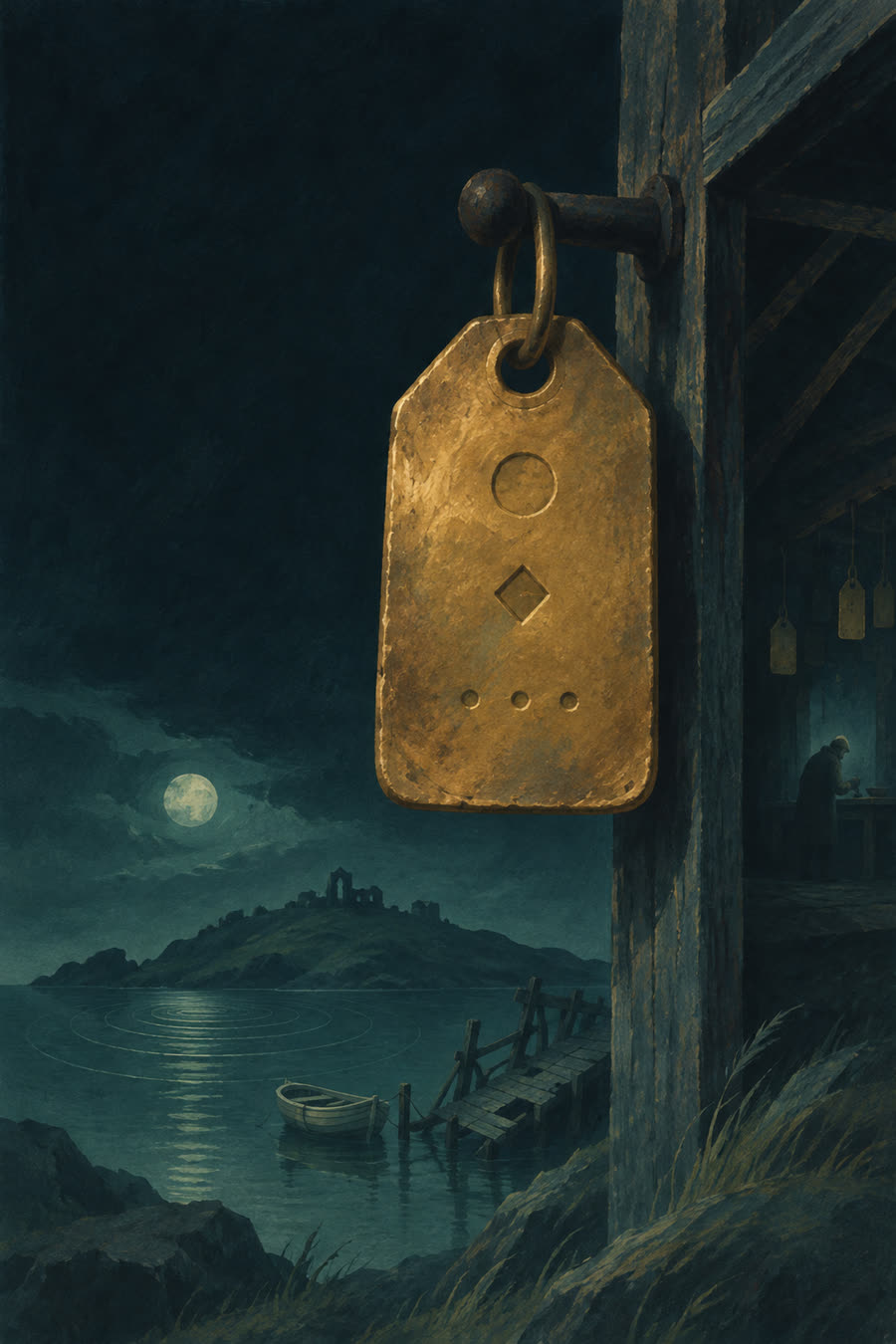
The boat was lighter than a boat had any right to be, but it was awkward, and Piers walked backwards through the net shed door with his elbows high and his breath short. Odda took the stern. The iron tiller swung against her hip with every step, cold as a coin through her coat.
"It is ticking faster," Piers said.
"I can hear it."
The bow tag knocked against the hull like a fingernail on a table. Odda did not look at it. She had spent thirty-one years reading what a tag said before she touched the thing it hung on, and it was strange to carry something while the tag was still making up its mind.
The wind had dropped. The harbour lay flat and black, and the only light came from her mother's red lamp, still burning at the end of the quay behind them. It laid a long pink smear down the wet stones of the slip. At the bottom of it stood the figure, no taller than a child, in a coat that reached the ground. The lantern sat on the stone at its feet, shuttered now.
"Do not stop," the figure called. The voice was dry and unhurried, neither young nor old. "If you stop to look at me, you will stop to doubt. Carry it down."
"Who are you?" Odda said.
"Someone who was told to be here. Your mother told me, in the winter before she hung the first tag. She said a woman with her jaw would come with a stranger from over the water, and that the stranger would be reluctant."
Piers made a small noise. "I am not reluctant."
"You have an order in your pocket to break this boat," said the figure, "and you have not broken it. That is reluctant enough."
Odda felt the boat shift as Piers's grip tightened, and she said nothing. Her mother had known about the order. Her mother had been dead nineteen years, and the Directing Office had signed its order only this autumn.
They reached the top of the slip, and the old planks groaned. Slip, Unsound, said the tag nailed to the post, and Odda stepped over it without reading the back. The stones were slick. Halfway down, Piers slipped and caught himself, and the boat did not so much as dip in his hands, as though it were holding itself up for him.
"Look," he whispered.
The bow tag had gone quiet. On its front the old stamp had changed while they walked: Pilot, Sleeping had become Pilot, and then a blank where the second word had been, and the brass there was warm to the eye, the colour of a coal just breathed on. On the back, the new word had finished rising. Odda turned the tag with one finger.
It said ALDANE.
Piers stared at it for a long moment. "That is my name."
"It is a common name on the mainland," he said, and then, more quietly, "It is not that common."
"It is the name of the last man who carried this boat from the island side of the water," said the figure. "Your mother's note told you two. It did not tell you why the second must be from away. That is a longer story, and the tide will not wait for it."
Odda looked at the black water, which had begun, very slightly, to move toward the slip, though there was no wind to move it. Somewhere in the schoolhouse the grey cabinet was humming through the night, patient and sure of everything.
"One question first," she said to the figure. "Before this boat touches the water. What is your tag?"
The figure lifted the hem of the long coat. Pinned to the lining, where a heart would be, hung a small brass tag, stamped so many times that its words had worn to a shine.
"Read it," the figure said.