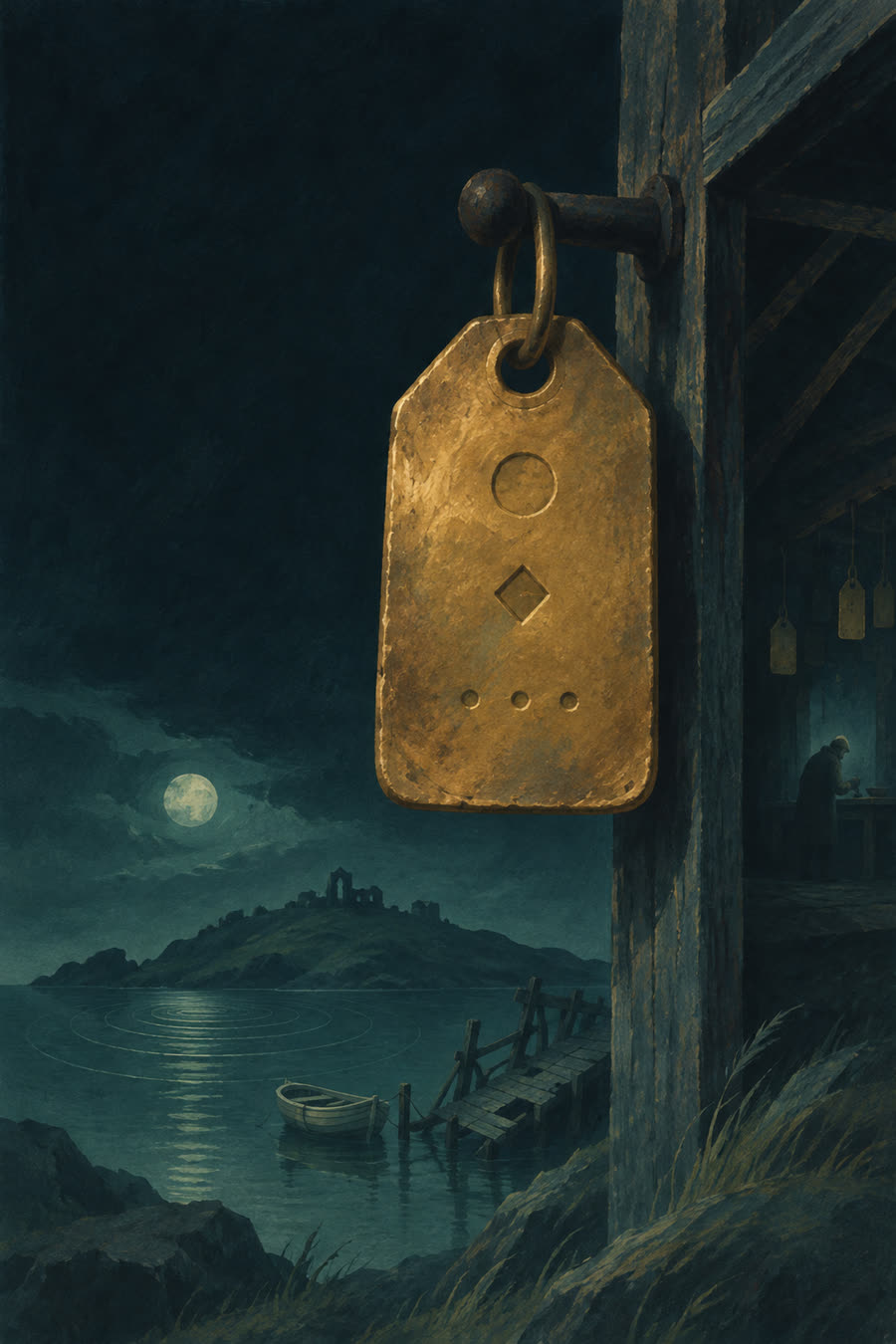
Odda did not answer at once. She put her hand into the pocket of her apron, where thirty-one years had worn a hollow, and brought out the small hooked knife her mother had used to cut wire for the first tags. The blade was no longer than a thumb. She held it out handle first, the way she had been taught to hand over anything sharp, and Piers took it with the hand that bore the backwards stamp.
Behind them the bell rang. Odda's pencil had worn to nothing, so she pressed her thumbnail into her wrist and made the fifty-second mark, a little crooked. On the water the oarsman did not look round. The two women kept their jars lifted, and the light in them leaned toward the boat as though it were being poured.
Piers knelt on the slip and laid the ledger on the wet stone. He did not hurry. He found the edge of the painted strip inside the back board, where the grey paint had been laid thick to look like the board itself, and slid the blade under it. The paper came away in a curl, brittle as old skin. Odda held her lantern close. Under the paint the ink was brown, small and upright, and plainly the same hand that had written the rest of the book.
"It is only a few lines," Piers said. "The top is gone."
He read it slowly, and Odda found that she was counting his breaths against the bell without meaning to. The strip said that the passenger was not the debtor and had never been. He had been put ashore as the receipt, so that the count would have something to hold which could not be lost, burned or argued with. While he was kept, the debt stood owed. If he were ever paid out, the count would close, and whoever had written the debt would be written in the margin in his place, unless the one rowing him agreed to take it up.
Piers stopped there. The rest of the strip was only a torn edge and one word, which might have been "unless" or might have been "unwilling."
"So he is not owing," Odda said. "He is owed."
"I think so." His voice had gone thin. "And the hundred strokes do not pay anyone. They only make every tag say sound, so that nobody asks who holds the receipt. Then the Cabinet closes the count, and the margin takes whoever is nearest the pen."
"You."
"Or whoever pulls the boat." He looked up at her, and she saw that he had understood the second half before he said it. "It says the one rowing. The crew were never hired to row him anywhere, Odda. They were hired to keep the rowing going until somebody else took the oars and the debt with them."
The oarsman had stopped looking at the water. He was looking at the ledger, and his face, which had been patient all evening, did something Odda had not seen it do. It was not anger. It was nearer to the look of a man who hears his own name called in a crowd and cannot yet tell who called it.
The figure in the long coat stirred on the slipway. It lifted its head for the first time since Piers had come back, and the tag on its breast swung and caught the lantern. Where it had read Kept, it now read, in letters Odda would have sworn were newly stamped, Asking.
"Fifty-two," the figure said, quite gently. "You have counted well, Odda Fenwick. Now put down the knife and tell me whether you mean to row."