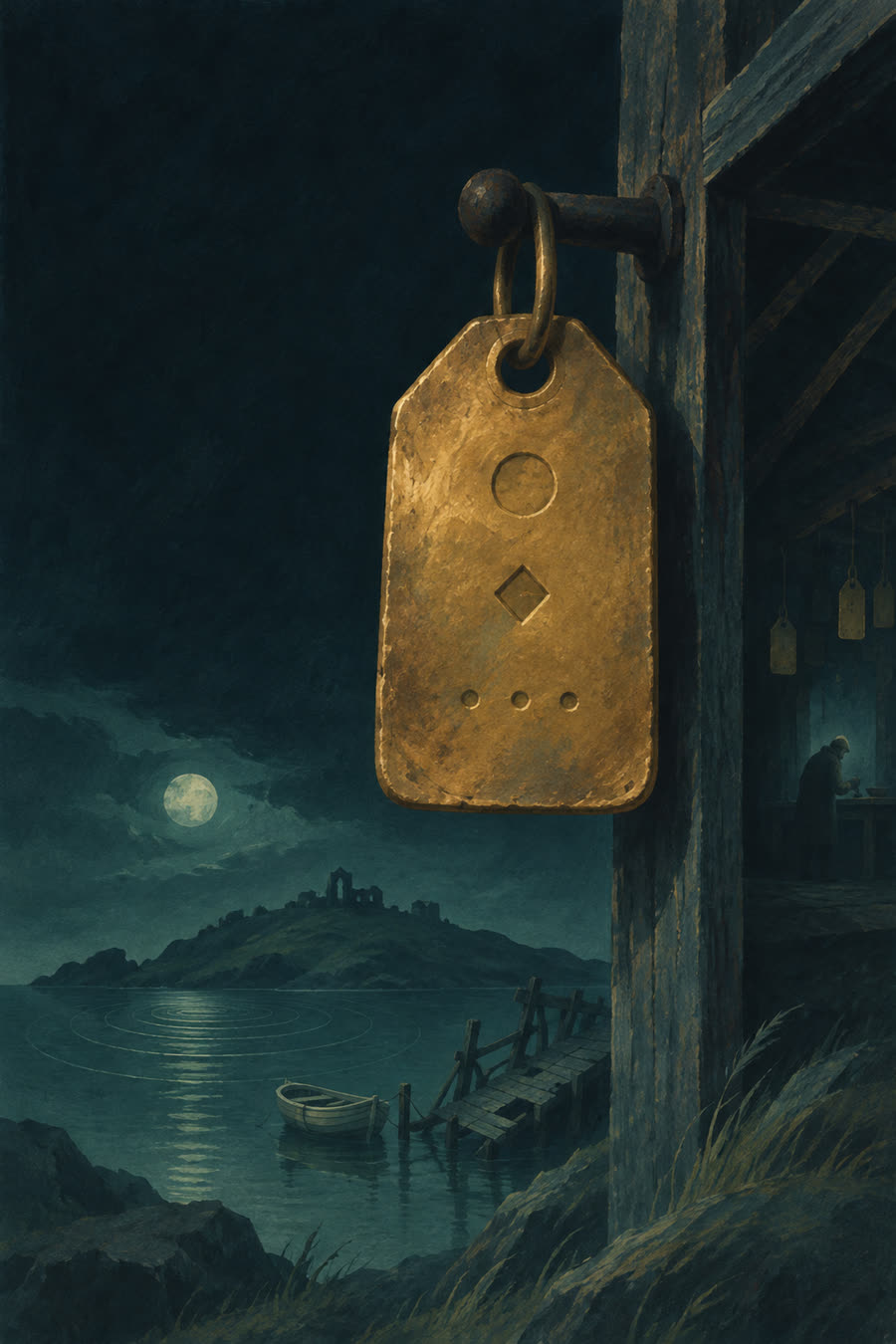
The schoolhouse lane was loose shingle, and Piers took it badly, the ledger clamped against his ribs like a stolen loaf. Behind him the Cabinet hummed, paused, hummed again. Each pause was a stroke somewhere out on the water. He did not count them. He had learned in the cellar that counting was what the whole island had been doing for a hundred years, and doing it for someone else.
The bell rang as he reached the harbour wall. One note, flat and patient. He ran down the steps two at a time and nearly went into the water at the bottom.
The condemned slip was lit pale yellow by the jars the crew held. The boat sat at the water's edge with its pale ribs showing through the wet. The iron tiller had swung hard to seaward, and the oarsman sat in his skiff with his hands in his lap, waiting. The two women stood on either side of the bow. The figure in the long coat stood on the slipway itself, quite still.
Odda sat on an upturned crate with her left hand open on her knee. Piers saw the marks she had made on it in pencil, five bars and a slash, again and again, climbing past the wrist. She did not look round.
"Fifty," she said. "I stopped trusting the bell and started trusting my own breath. Did you find the rope?"
"There is no one at it." He was gasping. "The Cabinet is the one counting. And the count is not a machine, Odda. It is a place. A pile of owing, and the island is where it was put." He held up the ledger. "My great-grandfather's father, or whoever he was, left a man unpaid and wrote that the count would hold it for him. It has been holding it ever since. Every tag you hung is a receipt for something that was never settled."
The oarsman lifted his head at that. It was the first time Piers had seen the whole of his face, weathered and not unkind, with the tired look of a man kept past his shift. "Read us the end of it," he said. "The last page."
"There is no last page. It is torn." Piers opened the book to show the ragged stub against the binding. "Someone took it out."
"Someone did," said the nearer woman. Her jar flickered. The tag at its neck read Borrowed, and beneath it, in smaller stamping, Returnable. "We were never told who."
The figure spoke at last, and its voice had no more weather in it than a ledger has. "Then you have read the part that does not matter. The hire ends when the debt ends. A hundred strokes end it. I told you this at the start of the night."
"You told us it would write me off as paid," said Piers. "You did not say who was paying."
Nobody answered. The bell rang again. Odda made a slash on her hand and drew a new bar beside it, and the sound of the pencil was very loud.
Piers looked at his palm, at the backwards stamp that had come up on it when he let go of the boat, and he understood a thing he did not like. A debt written off was not a debt cancelled. Somebody's name went in the margin instead. Somebody was already standing on the island who would be hauled in on the line when the count closed, and the stamp said ALDANE, and he was the only one of those left.
He turned the ledger over and found, pressed flat against the inside of the back board, a strip of paper no wider than a finger. It had been glued down and painted over to look like the lining. Along one edge ran the torn fibres of the missing page.
"Odda," he said. "Have you a knife?"