Odda heard him, though she could not make out the words until the wind dropped. Then she heard all of it, and she understood it the way you understand a step that is not there in the dark: with her whole body, a moment too late.
The desk. Of course the desk. Thirty-one years she had walked past it on the way to the schoolhouse stove and never once asked why a twin would be kept so carefully, moss and all, when everything else the Cabinet disliked was carted off.
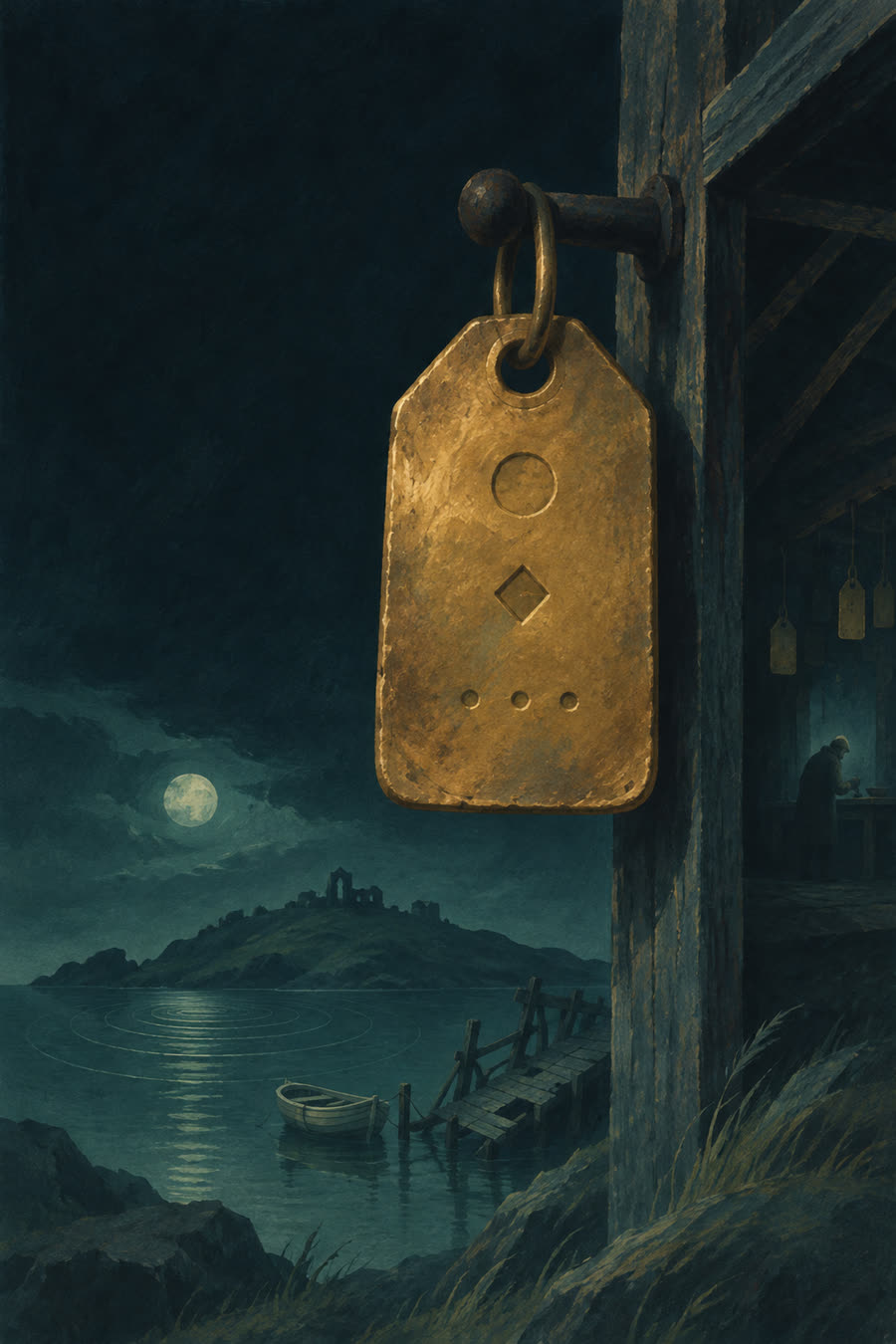
Down on the slip the water had gone strangely flat. It was not calm. It was held, like a sheet pulled tight by four hands. Out in the dark a line came up through it, wet and black and as thick as her wrist, running from under the old stones toward the bow of the pale boat. It did not whip or splash. It simply shortened, an inch, then another, and each inch it took the boat answered by easing a little further down the planks.
"Hold her," said the oarsman, and for the first time he sounded afraid. He had a rope's end in each fist, as though it might help. "If she goes out on that haul with no one at the oars, she goes out empty. Empty is a kind of answer. The count will read it as paid."
"Paid by whom?" Odda said.
The taller of the two women lifted her jar of light, and the tag on it turned in the glow. Borrowed. Returnable. "By whoever wrote the debt," she said. "You know who wrote it. Your mother's hand is on his tag."
The figure in the long coat stood at the foot of the slip, exactly where he had stood since the carrying. Now he turned his head. Odda had not yet seen his face plainly, only the coat and the stillness, and she braced for something terrible. It was only a face. It was tired, and it was perhaps forty, and it looked at her with the courtesy of a man who has waited a long time in someone else's hallway.
"I would row," he said. "I have asked, all this while. But the asking is what I am. A receipt cannot sign itself."
The bell struck. Sixty-nine. Odda made her mark on her wrist with a thumbnail and felt it bite.
Behind her, up the hill, a door banged. A small grey shape slid down the schoolhouse path ahead of the wind, turning over and over like a leaf: a card. It landed against her boot. NEW JOB, it said in the Cabinet's flat, friendly print. Gap nine hundred and six. Below that, a single line: THE LINE IS UNAUTHORISED. CUT IT.
She read it twice. The Cabinet had never been wrong, they said. It had never once been asked to be sorry, either.
"It wants it cut," she said aloud.
"Then cut it," said the second woman, quickly. A little too quickly, Odda thought. "Cut it and we are all free. Cut it and the boat stays on the slip and the bell closes the count and nobody has to row anything anywhere."
"And Piers is paid out," Odda said. "And the margin takes whoever wrote the debt."
None of them answered. The line took another inch. The boat's keel sang on the planks.
Odda looked at her mother's stamping on the stranger's tag, small and level and certain, and thought: she knew. She stood at this slip and she stamped it, and she gave me the tag room so I would be here when it came due.
Whatever the line was hauling toward, it was not hauling toward the grey cabinet's idea of sound. It was hauling the boat out. And a boat hauled out by something patient, with a willing hand missing from the oars, would go wherever the debt pointed.
She put the grey card in her pocket without folding it. She did not cut the line.
Instead she went down the slip, one hand on the wet rail, to see how heavy an oar really was.