The bell struck sixty, and Odda scratched the stroke onto her wrist with the pin from her collar. Forty to go. Nobody on the slip spoke. The oarsman leaned on his oar as if it were a fence post, and one of the women hummed over her jar of light until the other told her to stop.
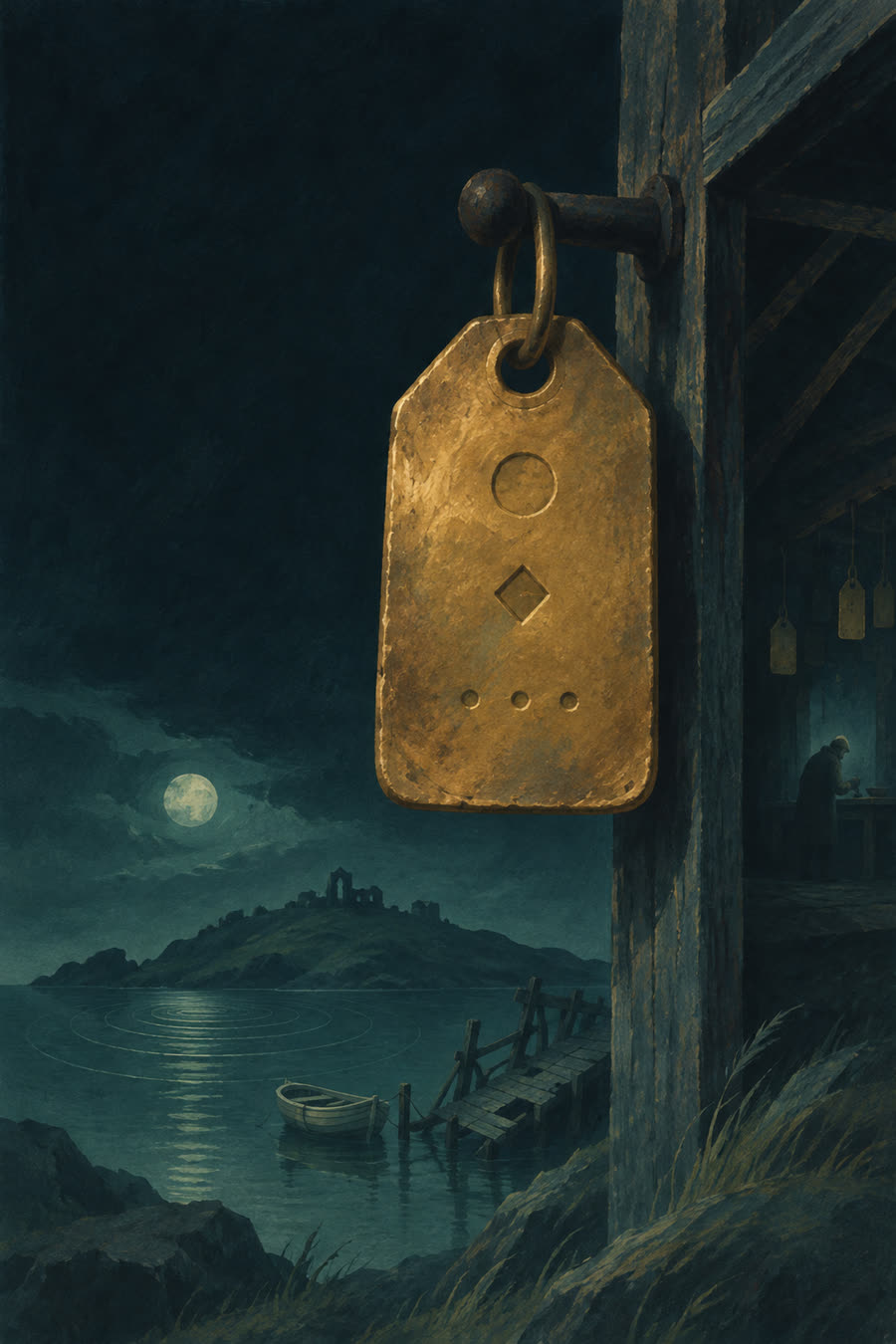
The boy came back at a run, boots slapping the wet planks, and he did not have a grey card this time. He held out brass. Odda took it from him and turned it to the lantern. It was a proper tag, stamped clean, with the Cabinet's hole punched in the corner the way the old ones never had been.
"Read it," Piers said. His voice had gone thin. He held his stamped palm against his coat as if it were cold.
"Slip sent by: desk nine hundred and six," Odda read. "Desk, not a person. Then a second line. Filled by: the twin."
The figure in the long coat turned its head, though it had said it could not turn itself, and Odda saw it was only the collar that moved, shifting in the wind. "A twin," it said. "So there is a desk for each of you. One was always going to sit empty."
"I've sat at a desk in the harbour office for three years," Piers said. "Nobody gave me a twin."
"They gave you a number," said the boy. He was out of breath and frightened, and said it anyway. "When I ran past the schoolhouse the door was open. There's a desk in there I never took notice of before. Two chairs, one desk, and it's got your name carved in the lid, mister, but the carving's old. Moss in the letters."
Odda felt the pin go still in her fingers. A desk with moss in the carving had been there longer than Piers had been alive. She thought of her mother's punch on the figure's tag, stamping *Put ashore by an Aldane* the day before she died. Someone had written Piers's whole errand a long time ago and then waited for him to be born into it.
"The ledger said the writer of the debt goes in the margin," she said slowly. "If the desk wrote the slip, then the desk is what the Cabinet keeps answering for. It sends you, Piers, because a desk can't row."
"And it can't be willing either," said the second woman, the one whose tag had flickered. She was staring at her jar. "Which is why it needs somebody who can."
The oarsman laughed once, short and ugly. "Don't look at us. We were counted out of that years back."
Odda looked at the boat instead. It sat at the water's edge with its pale ribs showing, patient, and along the slip rail two oars lay under their old tarpaulin, and she understood that the second oar had been left there for a second rower from the start. She had assumed she was only there to carry.
The bell began its ten breaths again. Piers breathed with it, in and out, his lips moving over the count, and she saw that he was not counting the strokes. He was counting the steps from the slip to the schoolhouse door.
"I want to see that desk," he said. "Before the hundredth. If it wrote me, I want to read what it wrote."
"The Cabinet will be sitting at it," Odda said.
"Then it can move over."
The figure said nothing, but a small brass sound came from the lining of its coat, like a tag turning over on its ring. Odda thought of every tag she had ever hung in thirty-one years, and for the first time wondered which of them had ever been hung on her.
She took the boy's elbow. "Run ahead and prop the door. Don't touch the desk."
"What if it touches me?"
"Then shout," said Odda, "and I will hear it from here."