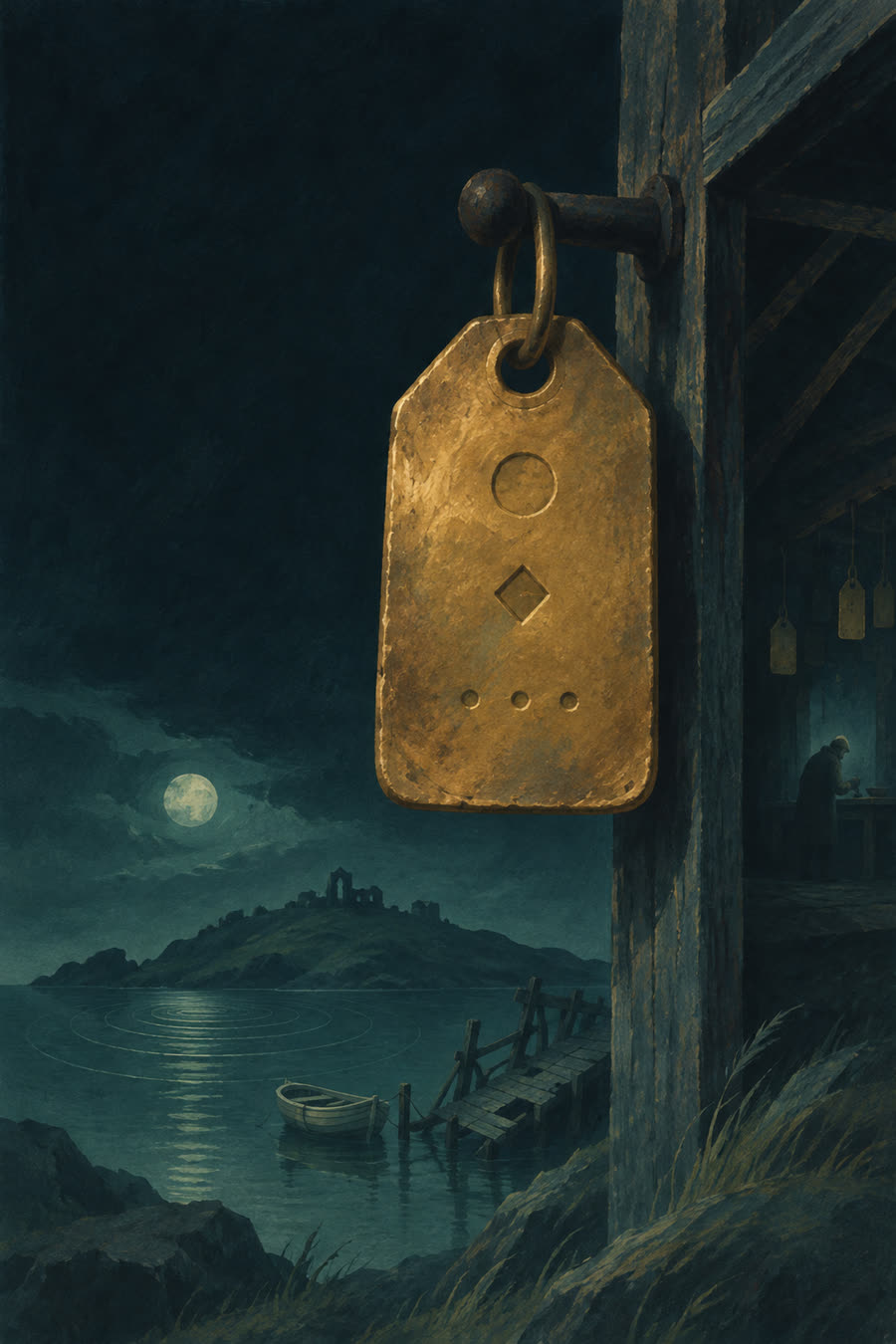
The bell rang from the schoolhouse, thin and flat across the water, and Odda scratched a fifty-fifth mark into the skin of her wrist with her thumbnail. Ten breaths to the next one. She did not have many to spend.
She held the strip up to what light the jars gave. The paint had come away in curls under her mother's knife, and the last word sat bare on the paper, pressed deep, the way her mother pressed a stamp when she meant it to outlast the tag.
"Read it," said the figure behind her. It had stopped laughing. "Please. The ledger would not say it, and the crew cannot, and I am not permitted to say what I am written on."
Odda read the line from the start, because it seemed wrong to arrive at a word without walking to it. "The passenger is the receipt, kept so the debt stands. If he is paid out, the count closes, and the writer of the debt is written in the margin, unless the one rowing takes it up." She stopped. There was more, after the comma she had taken for the end of the sentence. The old clerk had written it small, as if ashamed of it.
"Not unwilling," she said.
Nobody spoke. The oarsman's blade dripped. Somewhere under the slip a loose stone clicked and settled.
"Say the whole of it," the figure said gently.
"Unless the one rowing takes it up, and is not unwilling." Odda lowered the strip. "Willing is the condition. It cannot be hauled onto someone. It cannot be a trick, or an order, or a kindness done to a person who does not know what it costs."
Piers made a small sound, and she turned. He was staring at his palm, at the backwards stamp, as if it had just changed its mind about what it said. "Then I was never meant to row," he said. "I was meant to be put in the boat as the clerk who was owed. A hundred strokes, the count closes, and I am the name in the margin. They did not need me willing. They needed me to be the one the margin finds."
"Yes," said the younger of the two women, very low. "We were told to keep the stroke bad. Not to refuse you. Only to keep it bad enough that somebody would pity the boat and reach."
"And be willing out of pity," Odda said.
"Pity counts," said the older woman. She sounded as if she had argued this with herself for a year. "It is the commonest sort of willing there is."
The bell rang. Fifty-six. Odda made the mark and found her hand was steady, which surprised her. Thirty-one years of hanging tags had taught her one thing: a tag does not lie, but it will say only what it was asked. Every tag in this business had been asked the wrong question. Borrowed. Returnable. Kept. Nobody had stamped one that said Owed to whom.
She turned to the figure in the long coat. Its face, in the jar light, was neither old nor young, and had the patient blankness of an object that has been handled for a century by people who did not look at it.
"You are the receipt," she said. "Receipts are made out to someone. Who is the debt owed to?"
The figure inclined its head, as if she had finally asked the right thing, and it was almost glad to be asked. "That," it said, "is written on the front. Nobody has turned me round."
Far up the hill, the grey cabinet in the schoolhouse hummed on, and the bell rang a fifty-seventh time.